
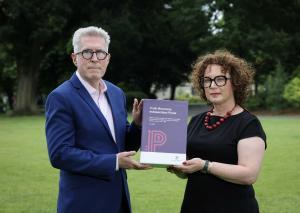
Truth Recovery Independent Panel publishes its final report into workings of Mother and Baby Homes, Magdalene Laundries and Workhouses in Northern Ireland
The Truth Recovery Independent Panel has today published its final report into Mother and Baby Institutions, Magdalene Laundries, and Workhouses in Northern Ireland, and their pathways and practices.
The 10-person Independent Panel was appointed in 2023 by the Executive Office to look further into the workings of the institutions and associated pathways and practices. This ‘integrated truth recovery process’ is a unique undertaking and involved new ways of working, including the Independent Panel working in collaboration with a public inquiry to establish acknowledgment, accountability and justice.
The Panel includes three victims - survivors. Together they have lived experience of the institutions and their pathways and practices, including the adoption, fostering and social care systems.
The Independent Panel provided a non-adversarial space in which victims - survivors, their relatives and others could share their experiences of the institutions and their pathways and practices. This approach was designed to prevent any further traumatisation of victims-survivors and to make their testimony available for use by the public inquiry, where participants have agreed to it.
This has resulted in the largest and most comprehensive collection of lived-experience testimony in Northern Ireland in connection to these institutions. The Independent Panel has written a comprehensive account of the hidden history of the institutions and pathways and practices.
At the heart of this account is the testimony and lived experience of victims - survivors. Their voices are at the centre of the report. Working with victims - survivors, the Panel has identified the aggregated truth.
In partnership with PRONI, the Independent Panel has also been responsible for gathering, preserving, digitising and analysing over 5,500 archival records from relevant institutions. This has created a significant resource base that will enhance greatly the work of the public inquiry as it begins its important task.
The Independent Panel’s final report includes 70 recommendations: 28 to the forthcoming public inquiry, 39 to the Northern Ireland Executive and 3 to future independent panels.
Key Findings and Emerging Themes
- Women and girls estimated to have been admitted to these institutions have been revised upwards to 12,062 admitted to Mother and Baby Institutions, and 3,750 admitted to Magdalene Laundries and Thorndale Industrial Home.
- The existence of these institutions shows clear evidence of discrimination against women and girls.
- The Panel identified a series of serious human rights issues during its work that will require further investigation by the public inquiry – some of which include:
- Systemic failures by the State to exercise effective oversight of what have become known as Magdalene laundries (in the context of Northern Ireland these were the three St Mary’s Homes, which were operated by the Good Shepherd Sisters) and Thorndale Industrial Home, which was operated by the Salvation Army.
- The Panel’s investigation points to a systemic failure by the State to exercise effective oversight of the Mother and Baby Institutions.
- The Panel’s investigation also points to systemic failures in relation to the oversight by the State of foster placements, boarding-out placements and adoptive placements.
- The Panel has enhanced the understanding of the pathways and practices relating to institutions, for example, the cross-border movement of children, and the role of some private nursing homes and private family homes in the concealment of pregnancy and in family separation.
- The role of Sister Z (in Marianville) merits special attention from the public inquiry, given allegations of abuse made against her.
- The adoption system and role of former Social Worker A who was involved in adoptions in NI should be further investigated by the public inquiry.
- A key theme emerging from testimonies shared with the Panel was the sexual abuse and rape of many girls and women prior to their admission to an institution. This was only one aspect of the gender-based discrimination that enabled the existence of these institutions and their pathways and practices.
- The Panel maintains that it is important that lessons are learned from the past and reflected in current strategies aimed at ending violence against women and girls.
Testimony
Learning from previous processes, the Panel engaged with victims - survivors using a trauma informed approach to testimony collection, providing a non-adversarial forum for those affected to share their experiences.
The final report draws from the testimony of almost 300 victims - survivors, their relatives and others with experience of the institutions. This includes 238 new testimonies shared with the Panel, in addition to 48 testimonies available from the Queen’s University Belfast and Ulster University research report, Mother and Baby Homes and Magdalene Laundries in Northern Ireland, 1922–1990 (Jan 2021).
Records
In collaboration with PRONI, the Panel has now gathered, preserved, digitised and analysed over 5,500 archival records from relevant institutions and organisations. This represents the largest number of institutional records ever made available to researchers, many of which have never been accessed before.
The Panel has developed comprehensive guidance on accessing records in response to the many victims - survivors who contacted them to outline their difficulties in accessing personal records.
The Panel has also recommended the establishment of a permanent independent archive to hold all records relating to historical institutions and the people who were admitted to them. The Panel’s recommendations draw upon discussions with, and survey of, victims - survivors on this matter.
Recommendations to the Public Inquiry
The Panel’s investigation, encompassing its final report, testimonies, and archival records, will provide a significant new body of evidence for the future public inquiry. It is hoped this work will be fully considered, alongside the Panel’s recommendations on areas the inquiry may wish to prioritise. They include:
- Victims - survivors participating in the inquiry are afforded core participant status and that the inquiry creates a mechanism to receive and consider testimony and institutional records considered by the Panel. (R1, 2 and 5)
In the course of its work, the Panel identified a range of serious human rights issues which warrant further investigation by the public inquiry. These include:
- Systemic failures on the part of the State in allowing the institutions to exist at all and its failure to exercise effective oversight of the institutions, including baby institutions, and over foster, boarding-out and adoptive placements. (R6 and 7)
- Many participants who engaged with the Panel spoke of abuse, neglect and inadequate care in mother and baby institutions. In many cases, their experiences amounted to degrading treatment, and in some cases, the experiences described are likely to reach the threshold of inhuman treatment. In particular, the conduct of Sister Z in Marianville merits special attention, given the allegations of abuse made against her by women who spoke to the Panel. (R10)
- Systemic deficiencies in the regime for the selection and inspection of foster homes, boarding-out placements and adoptive homes, leading to failures to protect some children in these homes against abuse and neglect. As these are part of the pathways of the mother and baby institutions, this warrants further investigation. (R12)
- Labour laws were not enforced in the St. Mary’s Homes (Magdalene laundries). In particular, women and girls were required to carry out work for which they were not paid and many experienced forced labour. The Panel’s investigation also suggests that women and girls who worked in Thorndale Industrial Home were not paid. (R14)
- The practices surrounding the giving of consent to adoption after a mother was admitted to a mother and baby institution. In particular, the practices of the social worker anonymised in this report (as Social Worker A) merit special attention. (R18)
- Marianville records indicate that between 1950 and 1970, it acted as a third-party adoption agency. This places the institution more centrally in the adoption process than the GSS have acknowledged in the past. The public inquiry should investigate the dual role of this institution. (R19)
- The Panel was not given access to records from Barnardo’s or the Sisters of Mercy in relation to the baby institutions they operated. These should be investigated by the public inquiry as pathways from mother and baby institutions. If legislative measures are necessary to permit this, the Panel recommends they are taken. (R22)
- A fuller analysis of the role of a number of private nursing homes and a small number of private addresses in facilitating family separations and an assessment of their role as de facto mother and baby institutions should be carried out by the public inquiry. (R23 and 25)
- There were some systemic weaknesses around the registration of births, making it possible for the births of some adopted children to be falsely registered. This should be further investigated by the public inquiry. (R26)
Recommendations to the NI Executive
- The Panel recommends the immediate appointment of the Chairperson of the public inquiry and regrets that synergies that should have been created between the Panel and the inquiry have been lost due to delay in establishing the public inquiry. (R29)
- The Panel recommends that Clogrennan mother and baby institution, Larne and Thorndale Industrial Home, Belfast are added to the list of institutions to be investigated by the public inquiry and to the list of institutions for the purposes of eligibility for redress. (R31 and 32)
- Women and girls who gave birth in workhouses and were separated from their children and these children separated from their mothers, should be included in the scope of the standardised payment scheme. (R34)
- The public inquiry should consider the list of private nursing homes the Panel has identified for investigation and, if it confirms they acted as de facto mother and baby institutions, they should be added to the list of institutions for the purposes of eligibility for redress. (R33)
- Baby institutions should be added to the list of institutions to be examined by the public inquiry as they operated as pathways from mother and baby institutions. (R35)
- The Executive Office should establish an effective mechanism and begin negotiations with those responsible for the institutions to seek financial contributions to the redress scheme. (R44)
Recommendations on Access to Records
- The creation of a central digital index of all NI adoption and care records (R47)
- Legislation to designate institutional records as public records and the establishment of a permanent independent archive to hold all records relating to historical institutions and the people who spent time in them (R48)
- The immediate provision of significant resources to the Health and Social Care Trusts to process requests for access to records (R49)
- Improvements to the storage and preservation of records held by health trusts and the Northern Ireland Courts and Tribunals Service (R50 and 53)
- The need for straight forward processes to apply for court records (R51)
- That a mechanism for access by adopted people to medical records of deceased parents be explored (R54)
- The immediate removal of means testing for legal aid for access to records requests by victims - survivors and their relatives (R56)
- That the Executive Office continues to support efforts to secure access to relevant records that are held in the Republic of Ireland (R57)
The Panel Co-Chairs, Professors Leanne McCormick and Sean O’Connell said:
“This report marks a significant milestone in the pursuit of truth and justice for victims - survivors who spent time in these institutions. Today we pay tribute to their fortitude and resilience. Carrying out this work has been a humbling experience. This is the most important work we will ever have the privilege of carrying out.
“During the past three years, victims - survivors have been generous with their time, revisiting difficult experiences and trauma, to bravely ensure their testimonies are recorded to inform the Panel’s report and to assist the public inquiry to bring justice and accountability to the institutions involved. Our hope is that those who have worked with us consider themselves the co-authors of the report. They have been fundamental to our understanding of what took place in the institutions and the enduring impacts, enabling us to offer our analysis, revealing the hidden history of the institutions and the associated pathways and practices.
“The Panel’s report includes testimony from almost 300 people who were directly affected by the institutions. We hope this, alongside our work with PRONI to preserve thousands of records for the first time, will help ensure that the work of the public inquiry can be carried out as swiftly as possible and that the goals of truth, acknowledgment and accountability are reached.
“We have greatly advanced our understanding of the issues and now have much more detail about how these institutions were run in Northern Ireland. Issues of gender-based discrimination, human rights abuses, degrading treatment, and forced separation of families are recurring and frequent. They should all be examined thoroughly by the public inquiry.
“Access to records also causes distress and concern for victims - survivors and we have been contacted by so many who felt frustrated and disheartened at how difficult that process has been for them. We hope the guidance we have developed will assist as many people as possible to access their personal records and we now have, for the first time ever, more than 5,500 records that are preserved for future generations. This will go a long way towards the establishment of an independent permanent archive of records.
“We have presented our report to victims - survivors and we have shared it with the First and deputy First Ministers. It is now for the Executive and a public inquiry to take this forward. Though a Chairperson has not yet been appointed for the public inquiry, the Independent Panel remains willing to meet and engage with them once they are appointed, to help assist the inquiry’s work. We will also be happy to discuss with the Executive the many recommendations that we have made which relate to it.”
The report is available to download here: Final Report
To request a hard copy of the report, please contact secretariat@independentpanel.org.uk, providing your full name and postal address.